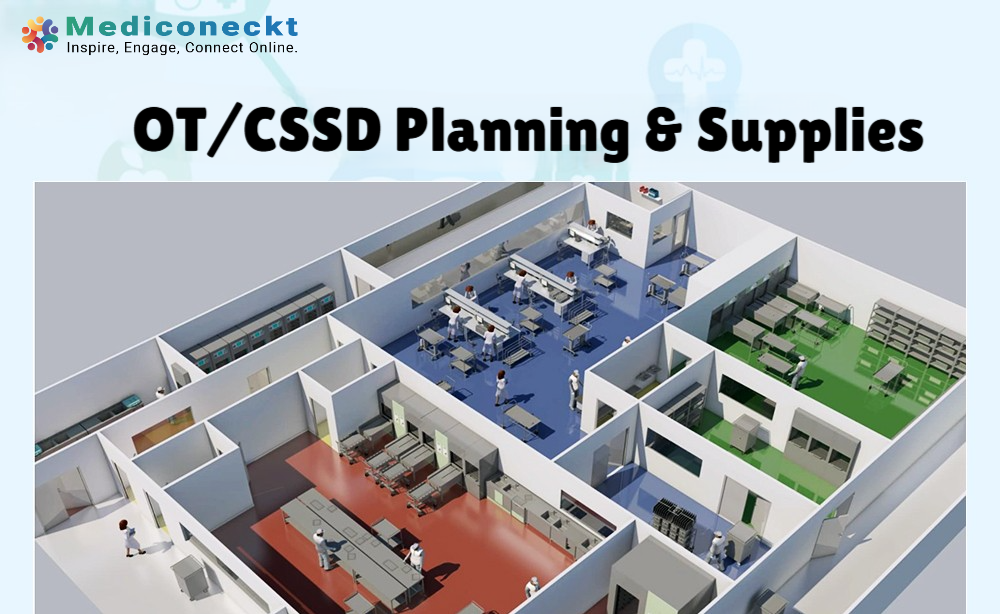

We create plans and source supplies for OT and CSSD to assist with organizing work processes, infection control, equipment layout, and safe medical device reprocessing.
The Central Sterile Supply Department (CSSD) plays a critical role in hospital operations. It is responsible for the centralized management of receiving, cleaning, assembling, sterilizing, storing, and distributing medical equipment and materials in a sterile condition.
This centralized hub ensures sterilization is carried out in a bacteriologically safe environment, under controlled conditions, with appropriate supervision — contributing significantly to lowering hospital-acquired infections.
With the evolving nature of healthcare infrastructure, the Hospaccx team remains engaged with the latest trends and developments in CSSD design. This overview highlights key considerations in planning and designing a CSSD. For in-depth consultation, please visit mdp.mediconeckt.com

Plan efficient operating theatres with practical layouts, equipment placement, workflow design, infrastructure planning, and essential clinical requirements.

Design organized CSSD environments supporting safe instrument collection, cleaning, inspection, sterilization, storage, and distribution processes.

Lorem ipsum dolor sit amet, consectetur adipiscing elit. Ut elit tellus, luctus nec ullamcorper mattis, pulvinar dapibus leo.

Optimize staff, instrument, and material movement through well-planned workflows that improve efficiency, safety, coordination, and infection control.

Support infection prevention with suitable equipment, supplies, and processing solutions designed for safe, hygienic, and controlled healthcare environments.

Planning focused on efficient space utilization, equipment positioning, staff movement, and smooth operating theatre workflows.
Support for identifying and planning essential OT equipment according to facility requirements and clinical applications.
Consideration of electrical, medical gas, ventilation, lighting, flooring, and other infrastructure requirements.
Planning different OT components together to create a coordinated and functional operating environment.
Designing functional CSSD layouts with appropriate areas for receiving, cleaning, preparation, sterilization, and sterile storage.
Planning workflows that support proper separation of dirty and clean areas and organized instrument movement.
Planning suitable spaces and equipment requirements for different sterilization processes.
Organizing sterile storage and distribution areas to support controlled handling and easy access to processed instruments.
Used and contaminated medical tools should be delivered in sealed units to a designated reception zone, which should be directly connected to the washing area and clearly isolated from clean areas. Unauthorized access to this zone should be restricted.
Cleaning aims to ensure all instruments are thoroughly washed, dried, and disinfected. Ideally, this step should be automated and consistently validated to maintain hygiene standards.
Post-cleaning, items are moved to the IAP room. This space must maintain higher air pressure than adjacent zones and be classified as a cleanroom environment. Staff should have a dedicated changing area for donning protective gear before entry. Direct access to a housekeeping area is also essential.
Handwashing and other water-related activities should be carried out outside this room to reduce contamination risk. Doors connecting IAP with washing and sterilization zones should be interlocked for added safety.
Steam is the most common sterilization method. However, alternative sterilization methods should be available for heat-sensitive instruments. These processes may require additional areas for preconditioning, degassing, or quarantine, in line with safety regulations.
Textiles processed through CSSD may be single-use or reusable. Regardless of type, they should be inspected, cleaned, and packed in a controlled setting to maintain sterility and meet quality standards.
Designated zones should exist for the receipt of soiled items and the dispatch of sterilized materials using trolleys and containers.
Facilities for staff to change from outdoor to work clothing should be provided, with personal lockers and separate toilets and shower areas accessible from but outside the main workspaces.
Staff at all levels should undergo regular training. A dedicated training space, separate from operational zones, should be allocated for educational sessions and material storage.
MIS helps track instruments throughout the sterilization cycle. All workspaces should be equipped with sufficient data points for seamless integration. Wireless systems are increasingly preferred, reducing the need for manual cabling.
Dedicated rooms for cleaning tools specific to each CSSD area are crucial to prevent cross-contamination between clean and dirty zones.
Waste disposal should comply with hospital policies and legal standards. Containers should ideally be foot-operated and covered to maintain hygiene.
The CSSD must have separate storage for unprocessed (raw) materials and sterilized products. Chemicals stored must comply with health and safety regulations. Proper inventory management ensures smooth daily operations.
Looking to plan, upgrade, or equip your OT or CSSD facility? Connect with Mediconeckt to discuss your requirements and explore suitable solutions.
Our OT and CSSD planning and supply solutions are suitable for healthcare facilities of different sizes and operational requirements.
For security purposes, please solve this simple puzzle to verify you are human before sending an OTP.